The forgotten old village of mass tourism
Les Matelles has 2,068 inhabitants on 16.9 square kilometres, at the foot of the Saint-Loup peak. A former cantonal capital, however, the village was less developed than neighbours like Saint-Mathieu-de-Tréviers, mainly because it is far from Montpellier-Ganges and Montpellier-Quissac. The result is an old village of the 13th century, on the left bank of the Lirou at the confluence of the Déridière, remained in perfect condition, with its medieval tower of Vias which once looked after the surroundings from the ridge.
From the accommodation, 28 minutes at the foot of the pic Saint-Loup
The route to Matelles is 22.2 kilometres and about 28 minutes by car from Saint-Jean-de-Védas. It is an exit that deserves a little, but in exchange offers a real rural change, just a few minutes from Saint-Gély-du-Fesc and the Triadou. The House of Consuls, the intercommunal museum of Prehistory installed in the old village, allows to put in context the remains of the region before going on a walk.
The resurgence of the Lirou and the caves
From a speleological point of view, the resurgence of the Lirou is a remarkable site : an escarpment of more than 20 meters dominates a waterfall as soon as the water flows, after crossing several caves and avens present in the commune. The landscape, between green oak and pine forest, lends itself to walking as much as to geological observation, in an area where the hills of the upper Jurassic gave a rocky soil and steep slopes.
Festivals, Occitan festival and creative market
The town remains lively despite its size : the votive festival of 15 August gathers many people, to which are added a medieval festival and the festival in Occitan "Lo Son dau Bartàs". A creative market regularly gathers potters and sellers of ancient books in the old village, another way to discover the commune than the only heritage visit.
A territory of protected garrigues
Les Matelles are part of a Natura 2000 area of 45,444 hectares, the "high garrigues du Montpelliérais", which houses three pairs of Bonelli's Eagles, or 30% of the regional population. Two natural areas of ecological interest are also recorded in the municipality, on 230 and 127 hectares, proof that this corner of garrigue remains one of the best preserved north of Montpellier.
A village of artists and scholars
Les Matelles saw the birth of the sculptor Pierre Granier, who participated in the sculptures of the Palace of Versailles. The novelist Albertine Sarrazin, who had chosen to live there, has been resting there since her reinhumation on 24 June 1978. Ossias Dumas, born in 1826 and died in 1874, and his brother Scipion, both linked to the republican history of the nineteenth century, are also among the village's personalities. In economic terms, the municipality had 152 establishments in 2019, of which 38, or 25 per cent, were in administration, education and health, compared with 14.2 per cent at the departmental level, alongside five wine-growing farms on 82 hectares. From a geological point of view, the north and west of the municipality form hills of the upper Jurassic, with rocky soil and steep slopes, while the hard limestones of the southeast dominate the Lez spring.
A studio for a quiet getaway in Matelles
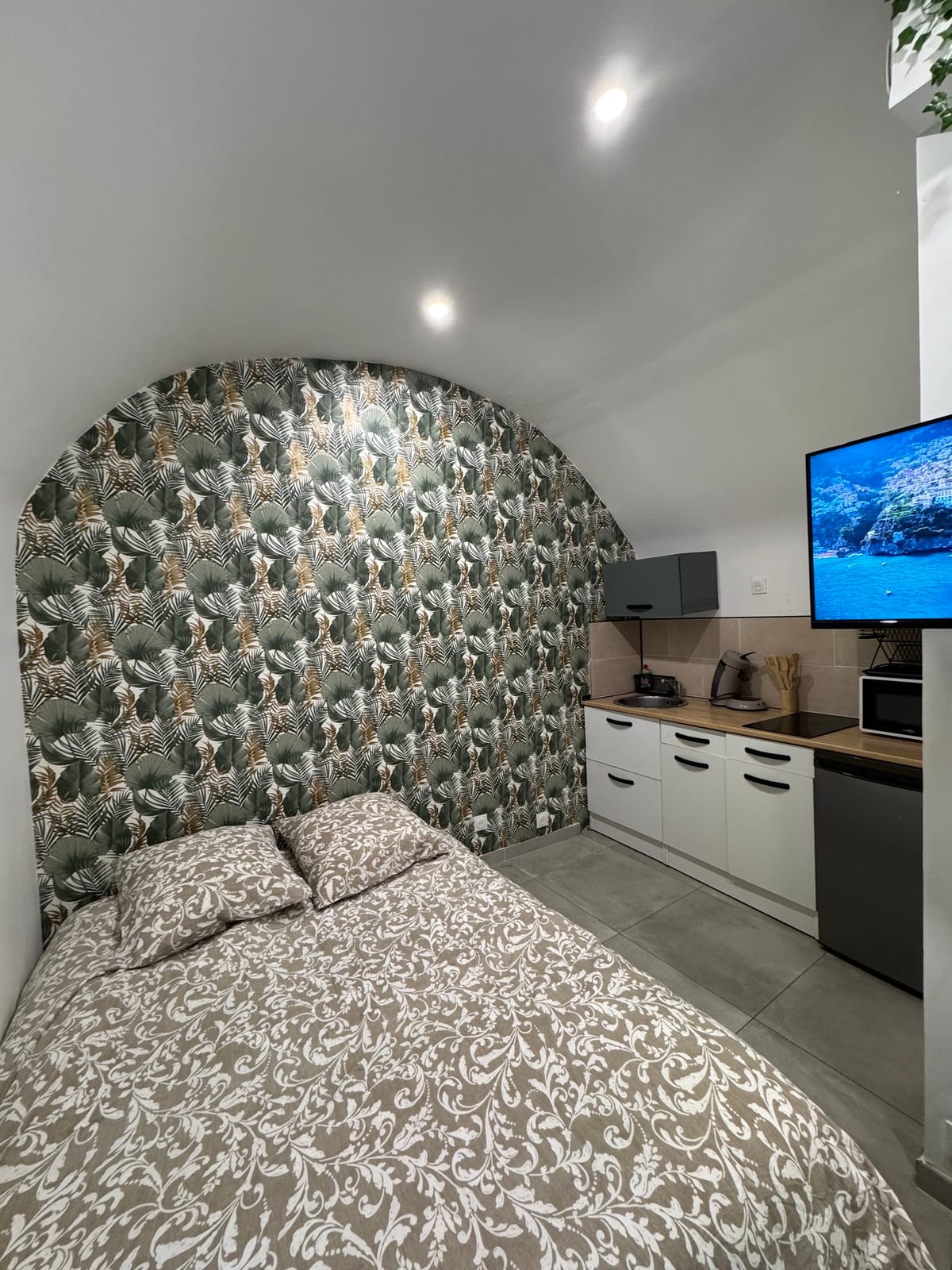
The studio, with its double bed and work space, is suitable for a couple who come to walk until the Lirou resurgence or stroll in the old village. For a family or group, the duplex offers two bedrooms and three beds, at the same address, in downtown Saint-Jean-de-Védas.
To continue north, the pages dedicated to Saint-Mathieu-de-Tréviers and Prades-le-Lez detail the neighbouring municipalities of Matelles.