The smallest village in the area, between sea and Cevennes
Plaissan has 1,718 inhabitants over 6 square kilometres. Surrounded by vineyards and garrigues, it is located 35 km east of Montpellier, 40 km west of Béziers and 30 km south of the sea, a central position between the coast and the first foothills of the Cevennes.
From the accommodation, 37 minutes, the farthest exit
The route to Plaissan is 42.4 kilometres and about 37 minutes by car from Saint-Jean-de-Védas, the longest distance from the area. It is an exit to consider for a full day, ideally combined with a nearby village like Gignac or Saint-Pargoire, rather than an isolated round trip.
Nine centuries of toponymy, from villa Plaxina to Plaissan
The name of the village comes from a Gallo-Roman estate, formed on the Latin gentile Placius. The ancient texts keep track of it in several successive forms : villa Plaxina in 829, de Plaisano in 1187, Playssano in 1323, Pleissan in 1571, before stabilizing in Plaissan in 1770. This continuity, rare over nine centuries archives, says quite the permanence of the same wine terroir around the village.
The Fontcaude source and the wisigoth tomb
The heritage of Plaissan lies in a few discreet landmarks : the church of Saints-Pierre-et-Paul, referred to in the general inventory of Occitanie, the chapel of Saint-Mamert, a wisigoth tomb locally called "Roman tomb", and a geological curiosity, the hot water source called Fontcaude. These are short visits, to be combined rather than seen in isolation, in a village that is not intended to occupy an entire day alone.
A long line of lords
Plaissan has changed hands several times over the centuries. In 1349, following a tragic episode, Arnaud II de Roquefeuil became its suzerain. In 1382 the Viscount of Lautrec took the seigneury, which his descendants would keep for a hundred years, before it was bought in 1483 by Hugues de Lasset. She then passed to the Baron of Florac, then to her son, known as "the Count of Plaissan", lord of the village from 1661 to 1701. The Count of Polastron became Viscount in 1765, before Louis François de Bourbon, Prince of Conti, bought Plaissan's property for 6,000 pounds, plus 350,000 pounds for other neighboring estates.
An economy still marked by vines
Plaissan had 83 establishments as of December 31, 2019, up to 131 in 2024, of which 21, representing 25.3% of the total, in trade, transport and catering, a proportion close to the 28 % observed across the department. The number of farms fell from 78 in 1988 to 44 in 2020, while the agricultural area used fell from 639 to 336 hectares over the same period, a sign of a wine-growing that concentrated on fewer hands without disappearing. This discreet economy also explains the absence of large tourist facilities : Plaissan remains a village where it comes for the calm of the vineyards and garrigue, not for an organized leisure offer.
A studio for a quiet escape
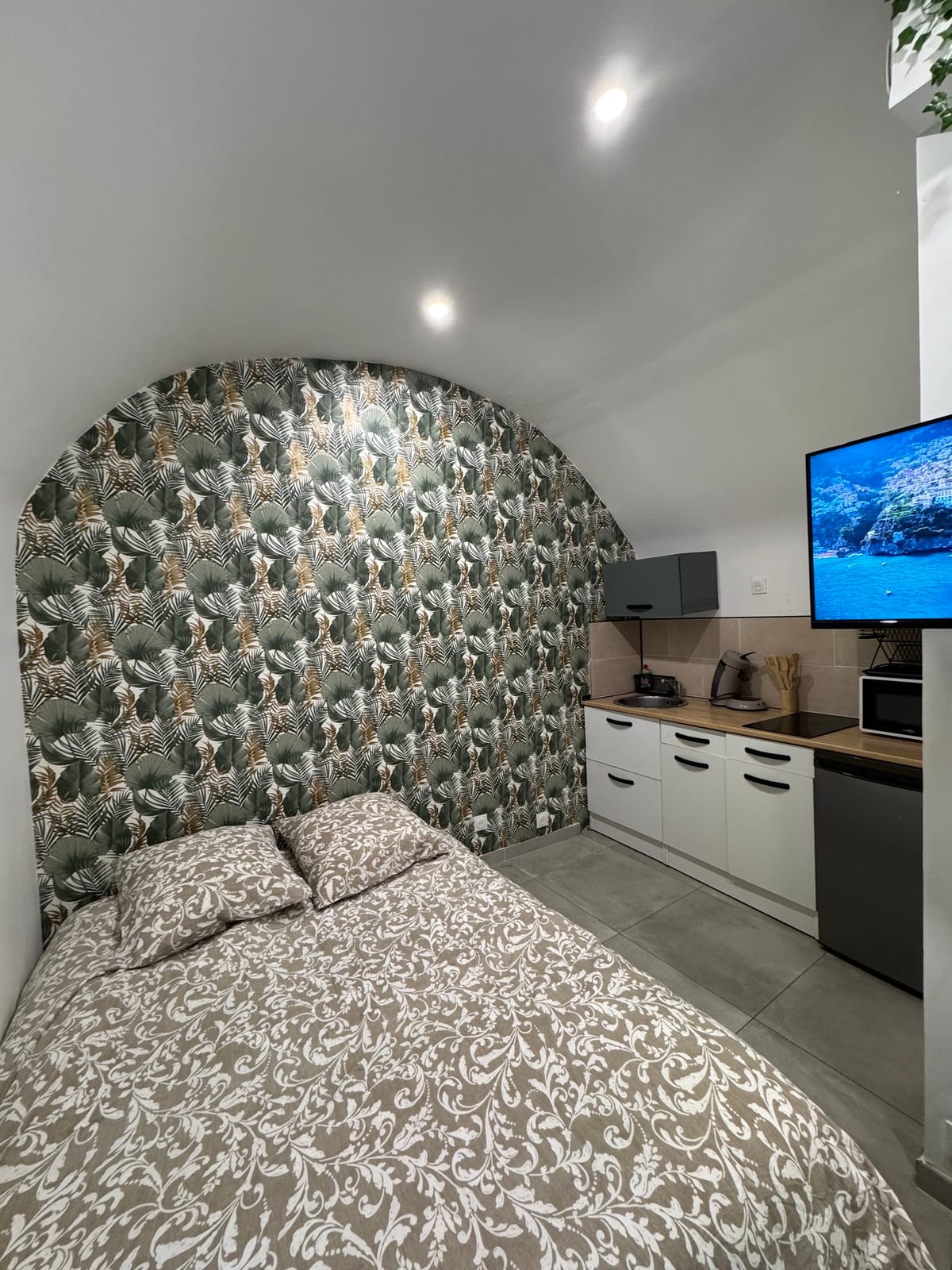
For a quiet exit away from the bustle of the coast or the center of Montpellier, the studio large enough, with its double bed and equipped kitchen for a simple meal on return. He's at the same address as the duplex, in the centre of Saint-Jean-de-Védas, with quick access to the A9 to take the road west of the department.
To continue to this sector, the pages devoted to Gignac and Saint-Pargoire detail the neighbouring municipalities of Plaissan.