A wine village between vineyards and garrigue
Saint-Drézéry has 3,006 inhabitants on 10.4 square kilometres, in the northeast of the Hérault. Until the 20th century, the town was called Saint-Drézéry de Courbessac. Born of a small hamlet belonging to the bishopric of Maguelone in the Middle Ages, it still had only 25 fires at the end of the 16th century. The vine has remained the main crop over the centuries, until today.
From the accommodation, 34 minutes to the AOC Languedoc
The journey to Saint-Drézéry is 32.1 kilometres and about 34 minutes by car from Saint-Jean-de-Védas. A town to book for a day trip, possibly combining it with a neighbouring village like Sussargues or Beaulieu.
The domain of Cambacérès, a revolutionary vestige
In the 17th century, the estate of Saint-Drézéry included a castle transformed into a monastery, partially destroyed by fire on 2 August 1790, as well as lands, vineyards and woods belonging to the chapter of the cathedral of Montpellier, which made it a resort for the clergy. This is where the young Jean-Jacques-Régis de Cambacérès, a future politician, stayed during his holidays with his uncle, archdeacon of Montpellier. Sold as a national property in 1791, the estate was awarded £50,100 on January 4, 1791 to a noun, who sold it to Cambacérès on January 12, 1791, for the same sum. When he died, Cambacérès bequeathed the castle to Montpellier Cathedral.
The church of Saint Didier and its frescoes
From the early church of the 12th century, there remains only the nave, which became the current choir after the collapse of part of the building in 1455. Agrandia in 1851, it houses three frescoes by the painter Nicolas Greschny, made in 1975 : a Supper above the tabernacle, a Christ Doctor in the choir and a scene inspired by chapter 12 of Revelation in the right nave. His bell, melted on 27 October 1776 by a Montpellieran master fondeur and blessed on 9 February 1779, completes this religious ensemble that remained intact.
The wine of Saint-Drézéry, a local appellation
The commune remains in the "Subergues", a small agricultural region oriented towards viticulture. The wines of Saint-Drézéry are classified in AOC Languedoc, and the estate of the Puech-Haut castle is one of its representatives. The castle park, now municipal, was acquired by the municipality in 1950 thanks to a loan from its own inhabitants, proof of an ancient local attachment to this heritage.
A building and vineyard economy
Saint-Drézéry had 247 establishments as of December 31, 2019, of which 52, or 21.1% of the total, were in the construction sector, compared to 14.1% in the department. The number of farms fell sharply from 55 in 1988 to 13 in 2020, while the agricultural area used remained stable at around 457 hectares. The present cemetery of the commune was blessed on May 10, 1852. The commune is part of the small agricultural region of the "Subergues", which occupies the north-east of the department, a terroir where the vine continues to shape the landscape much more than the recent urbanization of the Montpellierain agglomeration.
A studio for a wine escape
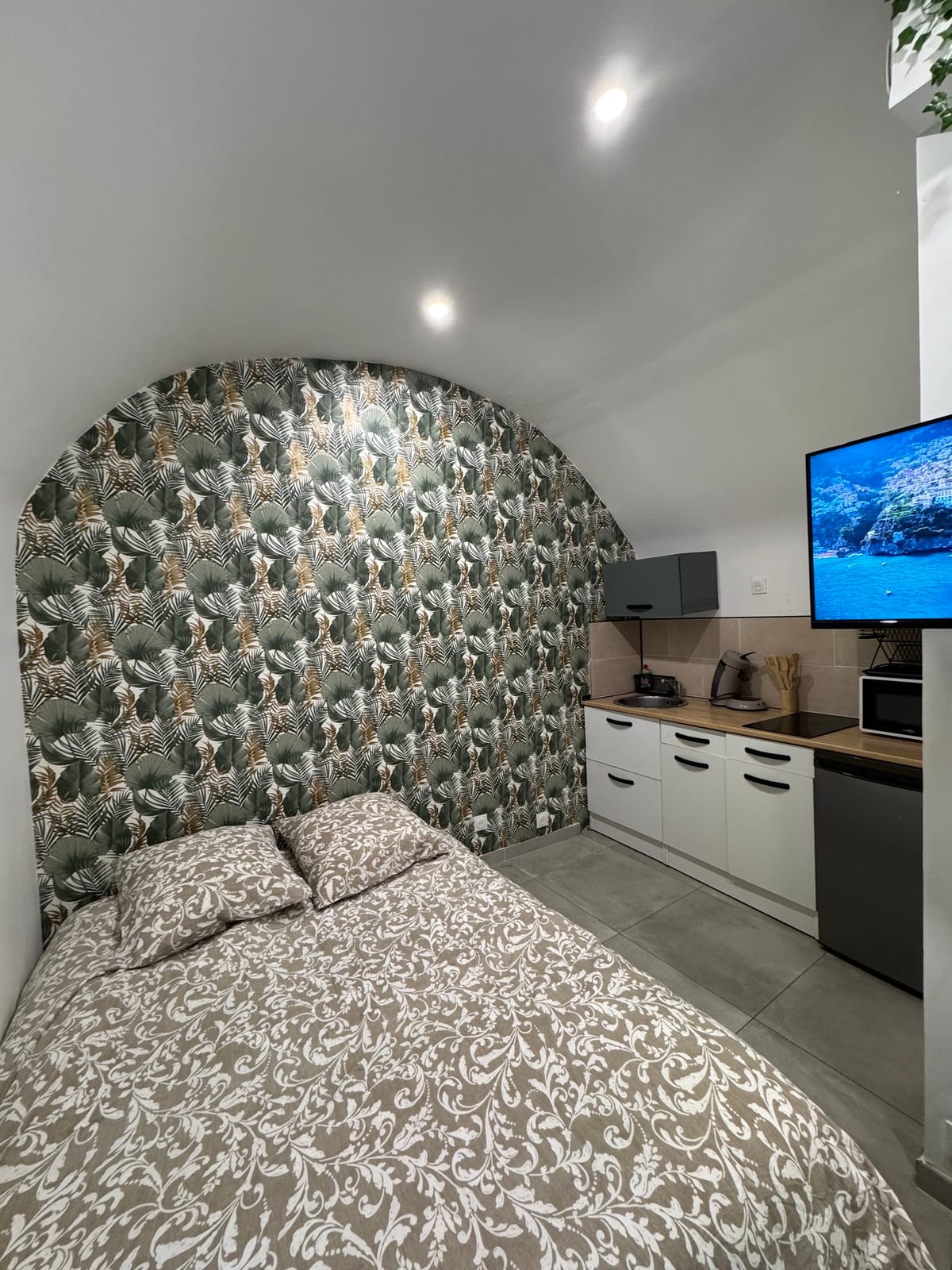
The studio, with its equipped kitchen, suits a couple coming to taste the wines of the AOC Languedoc and visit the village without hurrying. He's at the same address as the duplex, in the city centre of Saint-Jean-de-Védas, without minimum duration of stay, with quick access to the A9 to reach the north-east of the department.
To extend to the sector, the pages dedicated to Sussargues and Beaulieu detail the neighbouring communes of Saint-Drézéry.