A spa located on the pond of Thau
Balaruc-les-Bains has 7,139 inhabitants and is built on the banks of the Thau pond in the Sète agglomeration. The whole life of the municipality revolves around two elements : warm water coming out of its basement, and salt water from the surrounding lagoon. With about 52,000 curators a year, it is the first spa in France, and one of the three in the Hérault with Avène and Lamalou-les-Bains.
The local economy is responsible for this task : trade, accommodation and catering account for 33.9% of the municipality's establishments, a higher proportion than the department's average. Since 1 January 2017, Balaruc-les-Bains has belonged to Sète Agglopole Méditerranée.
For a curist or a companion, the practical question is simple : where to sleep during days of care, in a quiet, with a kitchen and what to park? Saint-Jean-de-Védas offers a response of 21.5 kilometers, or 17 minutes' drive, with quick access to A709 and A9.
Where the bath water comes from
The thermal water of Balaruc-les-Bains rises by faults. It is captured at depths between 120 and 404 meters, exits at 50 degrees and reaches the thermal baths between 37 and 49 degrees. It is low-salt water, rich in calcium and magnesium, charged with trace elements, whose effects on rheumatism and osteoarticular trauma are recognized by medicine.
The sludge used during treatment, on the other hand, is not local : it comes from Dordogne, Forez and Limousin. A detail that interests those who prepare their cure and want to understand the process of care before arriving.
Maimona, the ancient city under the station
The Romans were already exploiting these sources. The ancient name of the town was Maimona, quoted in the cartular of Maguelone in 1130, and the texts of the twelfth century then speak of Aix, i.e. "the waters". Remains of a thermal establishment were discovered in 1863 and 1865, and modern excavations revealed a city of about ten hectares.
The discoveries followed : the necropolis of Pech-Méjan in 1980, a shrine of Neptune near the school group in 1985, the Domus du Vendémaire in 1990, and the ancient thermal baths under a square in the centre between 1991 and 1994. A temple in Mars, Avenue des Thermes, delivered a votive altar and many ex-votos. The water of the city came by an aqueduct of 5 kilometers from the sources of Issanka, through Balaruc-le-Vieux; pieces of the emperor's effigy brought it back to the first century.
The most legible vestige remains the Gallo-Roman basilica, inscribed in historical monuments (ref. Mérimée PA00103367). This religious building was dedicated to Neptune and its Nymphs, as indicated by an inscription discovered in 1665.
The Pech d'Ay : Romanesque chapel and ancient garden
Above the station, the Pech d'Ay dominates the pond. At its foot, the Notre-Dame-d'Aix chapel, also known as Notre-Dame-des-Eaux, dates from the 12th century. It is a Romanesque building built in blocks of shellfish limestone, listed as historical monuments in 1989 (ref. Mérimée PA00103765), bought by the municipality in 1994 and restored in stages.
On the hill, the ancient Mediterranean garden occupies nearly 2 hectares. Developed between 2012 and 2017 and labeled a remarkable garden, it is an ethnobotanical garden : the plants are presented according to the uses of ancient civilizations, according to what the archaeobotanic reveals. The route follows a chronological thread, in a decor built according to the principles of ancient gardens. For a curist, it is a short, effortless walk out between two sessions.
In the city, the Church of Our Lady of the Assumption, neo-Gothic, was built between 1855 and 1858. Elsewhere on the town, the cromlech and the menhir of the Pioch of Roumanis add two megaliths to this heritage.
Thau pond, nature side
The Thau pond is the largest of the Languedoc ponds, with 19.5 kilometers in its longest length. Two Natura 2000 sites cover the Balaruc-les-Bains area. The first protects large grasses of zosters in very good conservation condition. The second is for birds : the pond is a site of international importance for the pink flamingo, a wintering area for black-necked grebe, and it houses a colony of dwarf terns.
In the pond springs out the source of the Vise, a sub-lake ex-emergence, that is, a spring coming out under the waters of the lagoon. The nearby Gardiole mountain is also inventoried as a natural area of ecological interest.
On the gourmet side, the town saw the birth of two sweets : the "Bubbles of Balaruc", local confectionery, and the chain La Cure gourmande, whose first factory was installed in the former train station of Balaruc-les-Bains.
Accommodation 17 minutes from the thermal baths : studio or duplex
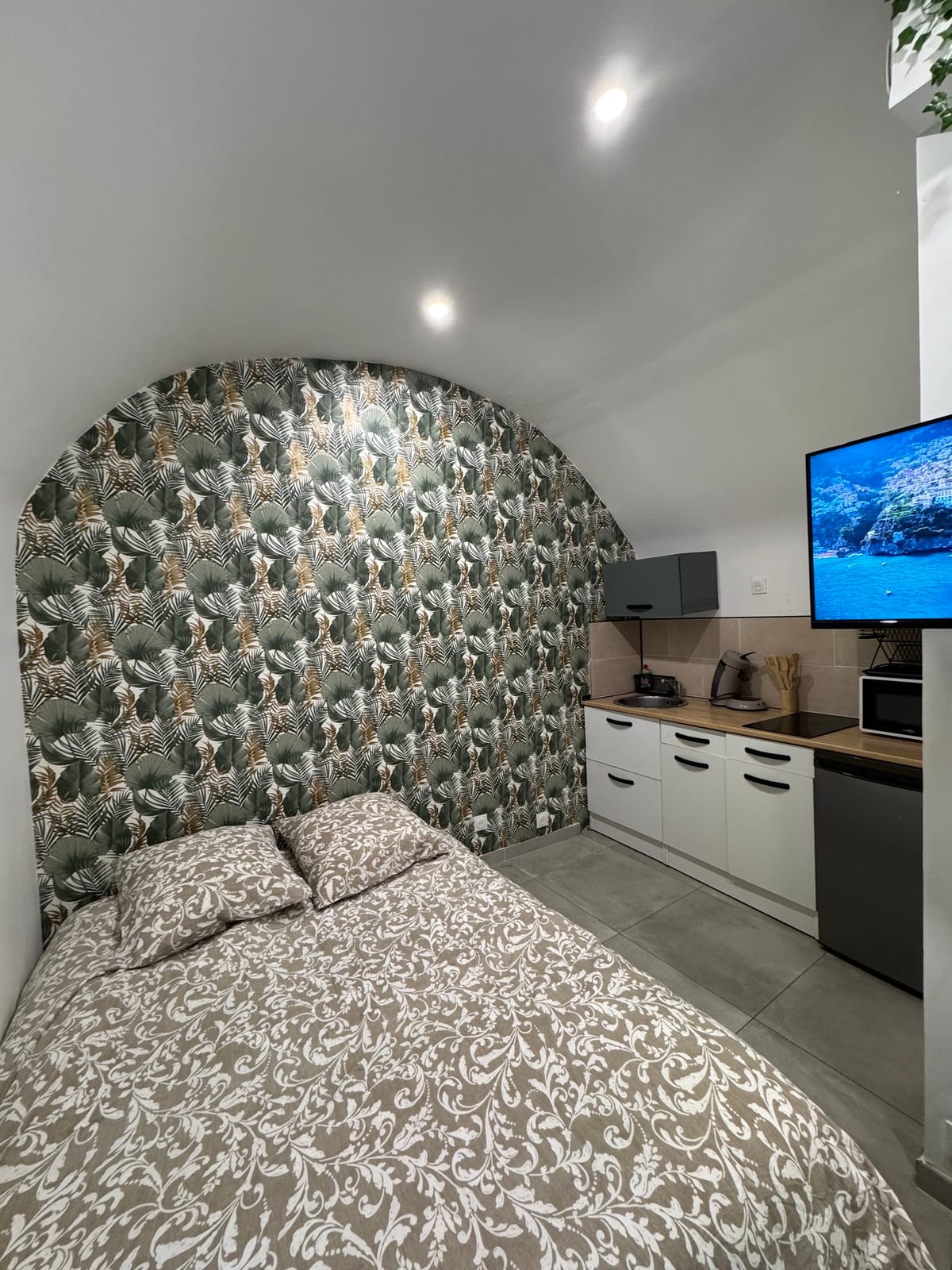
A cure organizes over time, with treatments that cut out the day. The studio suitable for a single person or a couple : double bed 140 × 190, kitchen equipped to cook meals, mobile air conditioning for hot afternoons, connected TV for evenings. It has no washing machine, a point to expect on a long stay.
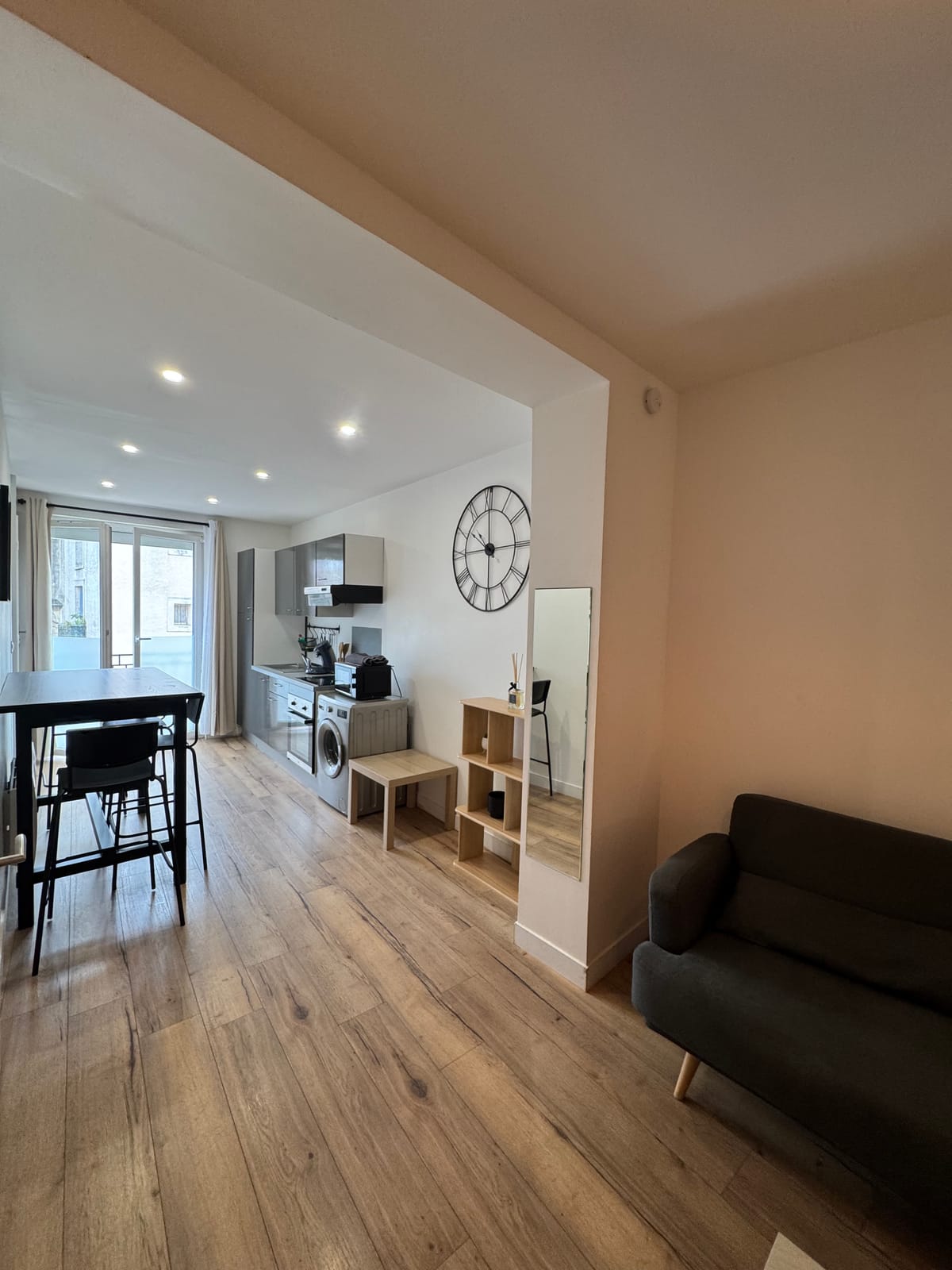
If a relative accompanies the curist, or if the family comes on weekends, the duplex offers two bedrooms, three beds, a bathroom and a half and a washing machine, for up to 4 travellers.
In both cases, the arrival is done in autonomy by key box between 5pm and 11pm, convenient after a first day of road, and free parking without time limit is 200 meters. On careless days, tram line 2, about 7 minutes walk, leads to Montpellier without taking the car. To extend around the pond, see the page dedicated to Bouzigues or that of Frontignan.